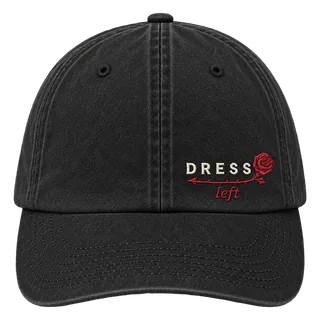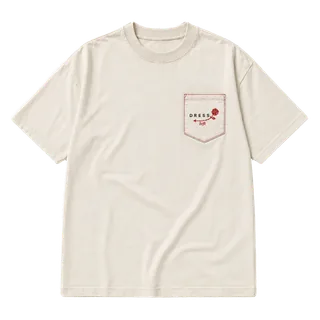
The brief was one sentence: draw a rose someone would wear before they knew what it meant.
That sentence rules out most of the obvious moves. It rules out slogans, because a slogan is the meaning arriving first. It rules out the clenched fist, which is a fine mark with fifty years of service behind it but reads as politics at forty feet. What’s left is the flower itself, which meant the whole job became a drawing problem: how do you draw a rose that isn’t a valentine, a tattoo flash sheet, or a bar of soap?
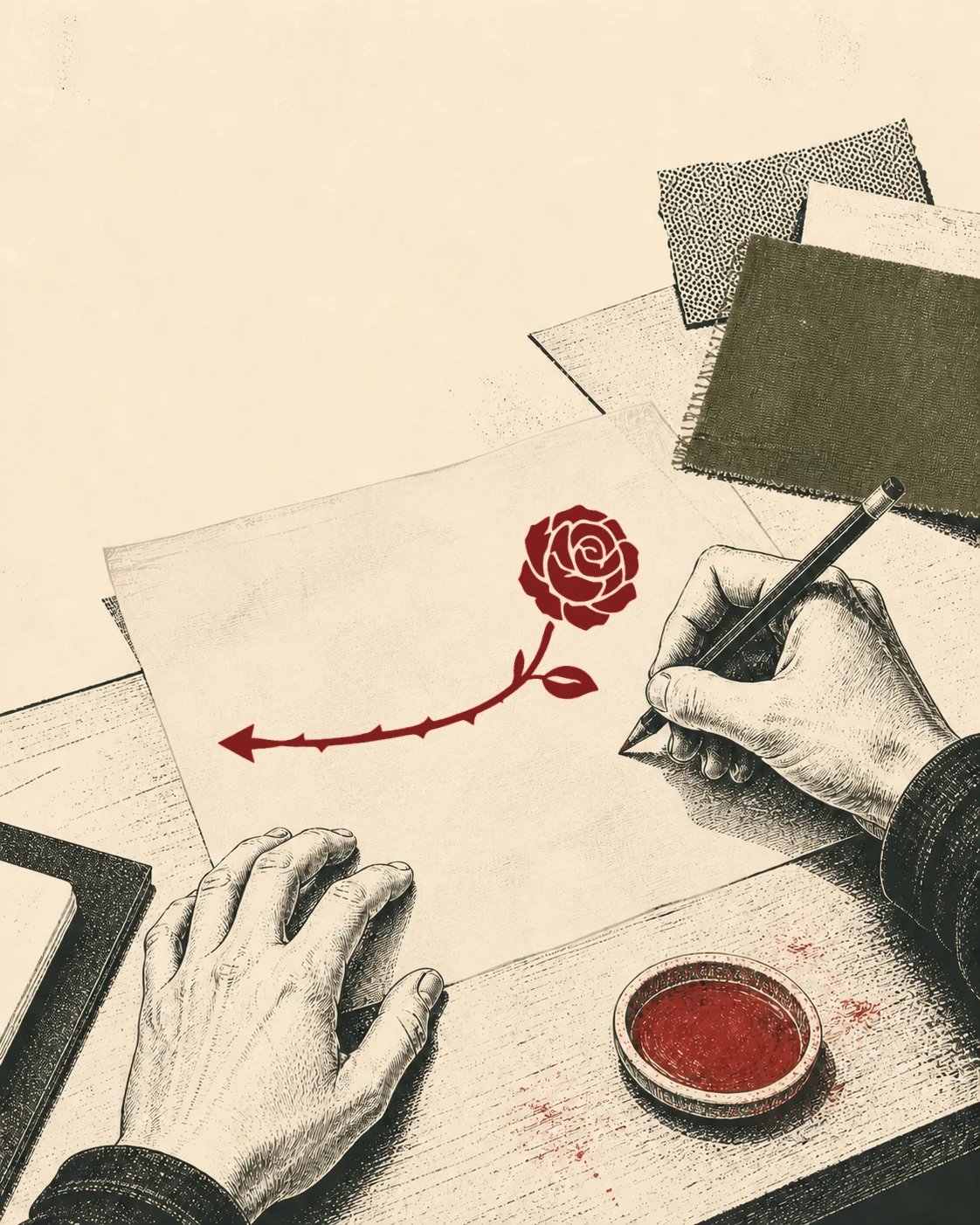
The answer came from the smallest surface we had to serve. A cap front gives an embroidery head about three inches and, if the design is honest, one or two thread colors. Detail dies at that scale; line survives. So the bloom is drawn the way a patient hand would draw it without lifting the pen: an outer petal ring, a spiral winding into the heart, one arc breaking the spiral so it reads as petals rather than a snail. Continuous-line roses are an old tradition for exactly this reason. They carry in one color, at one width, at any size.
The stem is where the mark becomes ours. Instead of ending in a cut stem or a pair of leaves, the line runs out horizontally, past two leaves, through a set of thorns, and sharpens into an arrowhead pointing left. The politics live in the structure of the drawing. No caption, no acronym, no explanation. Someone who knows the rose of the labor movement sees the whole sentence at once; someone who doesn’t sees a flower with an interesting stem, and both people are wearing the same shirt correctly.
Two smaller decisions did more work than expected. The thorns stayed, three of them, alternating along the stem, because a rose without thorns is a greeting card and the history this flower carries was not won politely. And the arrowhead is a solid barbed harpoon rather than an open chevron, because at embroidery scale an open arrowhead fills in and disappears while a solid one just gets smaller.
The mark now exists as exactly one drawing, used everywhere: the site, the chest prints, the cap, the tags. There is no simplified version for small sizes and no expanded version for large ones, which was the constraint that shaped it in the first place. When it animates on the homepage it draws itself in the order a hand would, bloom to stem to thorns to arrow, which is also the order it was designed to be read in.